Two completely different crafts that look similar on the surface
Pyrography and laser engraving both put dark marks on wood. Beyond that, they have almost nothing in common. One is a hand skill that takes months to learn and rewards patience. The other is a file-preparation skill that rewards precision and repeatability. The decision between them comes down to what you want to make and how you want to spend your time.
After 15 years of pyrography and time spent at laser facilities, here’s the comparison that the gear review sites won’t give you: an honest look at both, without trying to sell you on either.
How each method works
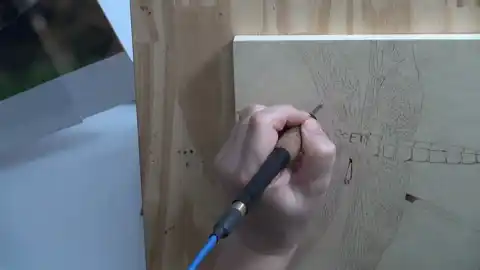
Pyrography uses a heated metal tip that you press and drag across the wood surface. The tip burns the wood fibers directly, creating a brown mark that ranges from light tan to near-black depending on temperature and dwell time. Every mark is made by hand, in real time, with your pen.
Laser engraving uses a focused beam of light that vaporizes a thin layer of wood material. A computer controls the beam’s path exactly, following the lines of a digital file you prepare in advance. The machine does the burning; you set the parameters and press go.
This fundamental difference shapes everything else about the two methods.
Startup cost comparison
Budget is usually the first question, so here’s a realistic breakdown.
Pyrography startup:
- A reliable entry-level wire-nib station (temperature control, 2 pens, 20+ tips): available at multiple price points
- Basswood practice panels
- Graphite transfer paper, a pen rest, basic safety gear
- Total to start creating on day one: affordable for hobbyists
Laser engraving startup:
- Entry-level consumer laser engravers: but typically limited in power and work area
- Mid-range machines that produce acceptable quality cost more
- Professional-grade laser systems represent a significant investment
- You also need design software (Adobe Illustrator or equivalent), proper ventilation ducting, and replacement consumables
- Total for a capable setup: considerably more than pyrography
For hobbyists testing whether they enjoy the craft, pyrography wins on cost by a wide margin. For someone starting a production business, the laser’s higher output volume may justify the investment over time.
See our guide to the best beginner pyrography kits for specific kit recommendations at different budget levels.
Learning curve
Pyrography: You can burn something recognizable in your first session. Steady hand pressure, consistent pen speed, basic temperature control — these take a few hours to feel natural. Most people are producing work they’re proud of within 4 to 8 weeks of casual practice. The skill ceiling is extremely high (portrait pyrography takes years to master), but the floor is genuinely accessible.
Laser engraving: The physical operation is simple — load the file, set the parameters, press go. The skill lives in software. You need to understand vector design programs, grayscale conversion for photo engraving, material-specific power and speed settings, and focus distances. Getting the file and settings right for a new material can take a full afternoon of testing. Once you know a specific material, you can reproduce results perfectly every time.
The key difference: pyrography rewards manual skill that builds session by session. Laser engraving rewards systematic knowledge that transfers across projects once acquired.
Artistic control and design freedom
This is where pyrography has a clear advantage for artists.
With a pyrography pen, you can change your mind mid-piece. Add a shadow you didn’t plan. Soften an edge with a different stroke. Respond to how the wood grain is absorbing the heat. The work is a conversation between you, the tool, and the material.
With laser engraving, the machine executes the file. If the file is right, the piece is right. If anything needs to change — a shadow is too dark, a detail is lost — you go back to the computer, adjust the file, and run a new piece. There’s very little room for spontaneous creative decision-making during the burn itself.
For one-of-a-kind custom art, portraits, and pieces where your hand is part of the work, pyrography gives you something a machine cannot. For consistent, professional-looking production runs, the laser’s precision is genuinely unbeatable.
What each method does best
Pyrography excels at:
- Custom portrait burning with realistic shading and tonal range
- Detailed wildlife and nature scenes where grain texture adds to the effect
- Personalized pieces where the handmade quality is part of the value
- Fine detail work and intricate line drawing
- Pieces where each one is different (commissions, art sales)
- Curved and three-dimensional surfaces like bowls, spoons, and boxes
Laser engraving excels at:
- Batch production of identical pieces (50 personalized keychains, 100 name plaques)
- Photo-realistic black and white images with consistent tone
- Complex geometric and technical patterns that require exact precision
- Non-wood materials: acrylic, leather, anodized aluminum, glass
- High-volume business applications where speed and consistency matter
If you’re making one unique piece for a specific person, pyrography is likely the better tool. If you’re filling orders for 20 of the same item, a laser makes more sense.
Portability and workspace requirements
Pyrography: A pen, a power cord, a rest, and a flat surface. The entire setup fits in a bag. You can burn on a kitchen table, at a craft fair, in a friend’s studio. Many pyrographers work from whatever space they have available.
Laser engraving: Even small consumer machines are bulky. They need a fixed workspace, dedicated ventilation (either an integrated filter or ducting to outside), and a connected computer. You can’t easily move the setup between locations. For apartment dwellers or people without a dedicated workspace, this is a real constraint.
Health and safety comparison
Pyrography safety: The main risks are burn from the tip and smoke inhalation from the wood. Both are manageable with basic precautions: a proper pen rest, ventilation (window and fan minimum, fume extractor for regular work), and not burning treated or painted wood. See our detailed wood burning safety guide for a full breakdown.
Laser safety: Lasers add a dimension pyrography doesn’t have: the beam itself is dangerous to eyes. Even indirect reflections from some laser types can cause retinal damage. Consumer machines have safety interlocks, but lower-cost open-frame lasers require laser-rated eye protection during operation. The smoke from vaporized materials is also a health concern, often requiring more robust ventilation than pyrography.
Pyrography is more forgiving for beginners because the risks are visible and intuitive. Laser hazards are less obvious and require deliberate safety practices.
Which should you choose?
Choose pyrography if:
- You’re a hobbyist, artist, or someone drawn to handmade craft
- Budget matters and you want to start creating quickly
- You want to work anywhere without a fixed setup
- Artistic control and personal expression matter more than consistency
- You’re making custom one-of-a-kind pieces
Choose laser engraving if:
- You want to start a production business with repeatable output
- You need to engrave non-wood materials at scale
- You have a dedicated workspace and budget for the equipment
- Perfect consistency and precision across a batch is the goal
Most people reading a pyrography site already lean toward hand burning. That instinct is sound. Pyrography is more accessible, more expressive, and gets you creating within hours of your first session. Start with a quality beginner kit, use the right wood, and build the skill. If your ambitions eventually grow toward production volume, a laser is there when you need it.
To get started with pyrography, see our complete beginner’s guide and our ranked kit guide. For wood selection, the best wood for pyrography page covers everything you need to know before your first session.
If pyrography is the right fit for you, the next step is gear. Our guides to the best pyrography kits for beginners, the best wood burning pens, and the best wood for pyrography cover exactly what to buy so you start on the right foot — and our pick of the best pyrography books will take you from first burn to real skill.
Common questions
Can I start with laser engraving if I have no design experience?
You can learn, but expect a steep software learning curve before you make your first quality piece. Programs like Adobe Illustrator, LightBurn, or Inkscape take meaningful time to learn. Pyrography has no software requirement — just the pen and the wood.
Is pyrography better than laser engraving for portraits?
For hand-rendered artistic portraits, yes. Pyrography lets you control tone and shading in real time, which creates work that looks drawn, not printed. Photo engraving on a laser produces a different aesthetic — technically precise but less artistically expressive. Both can produce impressive results; they just look different.
Can I use pyrography professionally?
Many pyrographers sell commissioned work, run Etsy shops, and teach workshops. The limiting factor is time — each piece takes hours. For small-batch premium custom work, pyrography is a viable business. For high-volume production, a laser is more efficient.
Does laser engraving require ventilation?
Yes, always. Laser-vaporized wood smoke contains many of the same VOCs as pyrography smoke, plus compounds from any coatings or adhesives in the material. Many consumer machines come with a basic filter, but a ducted extraction system is better for enclosed spaces.
Can I do both?
Yes, and some artists combine them. A laser can engrave a precise base layer or border, and pyrography fills in the tonal shading and detail. This hybrid approach is common among commercial artists who want speed and precision on structural elements but hand work on the expressive parts.
Can I combine wood burning and laser engraving in one piece?
Absolutely. Many makers layer the two techniques: use a laser for precise structural work, background patterns, or text, then add hand-drawn shading and detail with pyrography on top. The laser establishes the framework, and the pen adds warmth and artistic character. This hybrid approach works especially well for detailed portraits with engraved borders or for personalized pieces that need both speed and hand finishing.